-
WhatsApp / Mob : +86 156 5177 2521
-
e-mail : mrwin@cnbangwin.com
WhatsApp / Mob : +86 156 5177 2521
e-mail : mrwin@cnbangwin.com

Liquid Nitrogen Plant Working Principle: How Industrial LN2 Plants Produce Liquid Nitrogen
Jul 01 , 2026
A lot of manufacturers rely on a steady supply of liquid nitrogen for daily use. Hence, to avoid these costs a large number of companies tend to install these types of on-site production systems instead of buying liquid nitrogen from gas suppliers.
It will help the engineers to select the right equipment by knowing the Liquid Nitrogen Plant Working Principle. Additionally, it assists companies to reduce operating costs and enhance production efficiency.
Cryogenic air separation is still considered to be the best reliable technology, even today for producing high purity liquid nitrogen. Thus, industries across the globe are still pouring money into new liquid nitrogen plants.
Liquid nitrogen plants are employed for production of liquid nitrogen from atmospheric air by means of cryogenic refrigeration and air separation technology.
The process begins with compressing and filtering ambient air on the plant premises. Next, it cools the air again to much colder temperatures. Afterwards it goes through the process of fractional distillation to separate nitrogen from oxygen. Finally, it liquefies this purified nitrogen and stores the gas in insulated cryogenic tanks.
Industrial plants typically generate nitrogen with more than 99.999% purity; As a result they fulfil the needs of food processing, health care, electronics, drug manufacturing, as well as scientific research.
l Cryogenic Air Separation Plant
l Air Separation Unit
l Cryogenic Air Separation Equipment
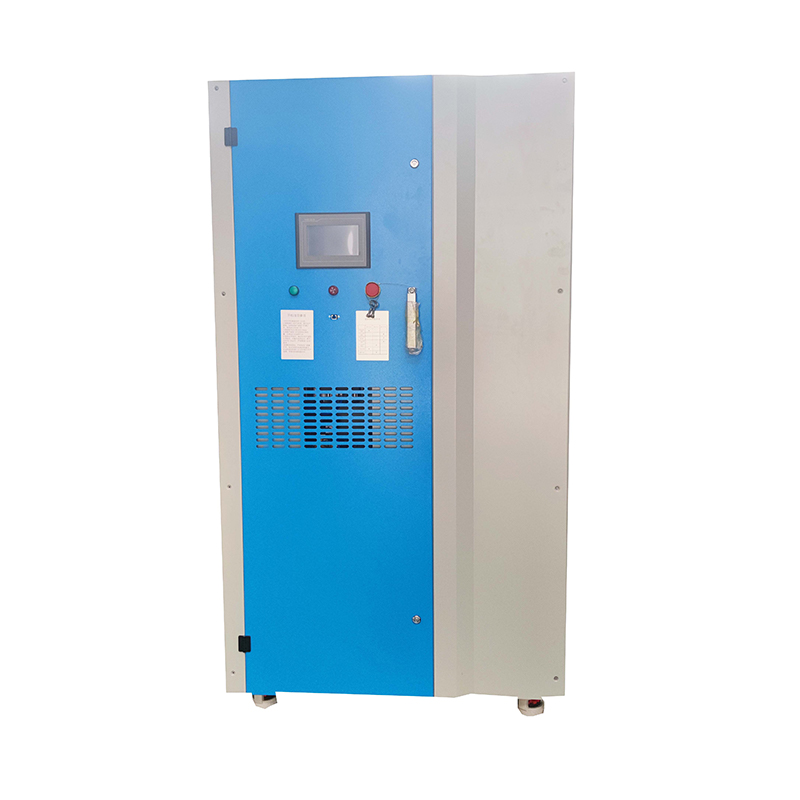
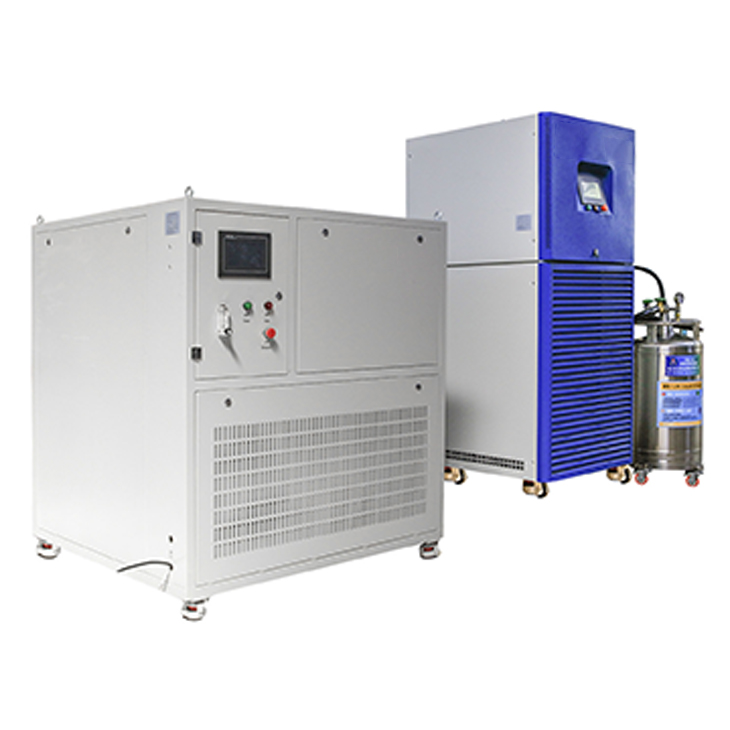
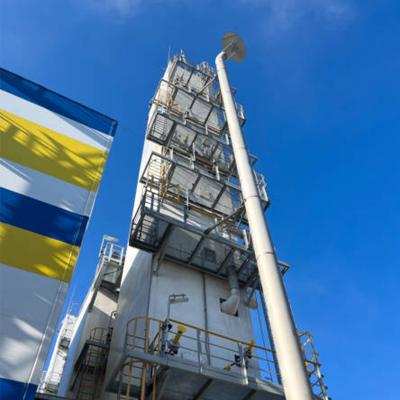
The fundamental working principle of a liquid nitrogen plant is that in the process atmospheric gases have various boiling points.
Liquid nitrogen boils around -196°C and oxygen at -183°C, so engineers use cryogenic distillation to separate them.
The overall process is divided into different steps.
The plant first pulls air from the atmosphere via an air compressor.
The compressor compresses the air.
Increasing the pressure leads to a more effective exchange of heat in later stages.
The next step is to run the compressed air through a purification system.
The purification unit removes:
l Water vapor
l Carbon dioxide
l Oil vapor
l Dust particles
l Hydrocarbons
This step is meant to save the cryogenic equipment.
Indeed, the clean air avoids needing any ice to be formed inside a cold box.
The purified compressed air then flows into the high-efficiency heat exchanger.
Cold nitrogen flowed outward cools incoming compressed air.
Hence the system saves power and reclaims cold energy.
This method significantly increases the efficiency of plants.
Then, some of the compressed air goes in an expansion turbine.
The air expands and it loses the pressure quickly.
Consequently, its temperature decreases dramatically.
Most of the refrigeration necessary for liquefaction is produced by the turbine.
Once cooled enough, it enters the Cryogenic Distillation column.
Inside the column:
l Where the Oxygen is in the bottom section.
l Nitrogen goes up to the upper part.
l Argon is concentrated in the middle part.
So the plant isolates each gas in a continuous manner.
The nitrogen cleans to -196 °C.
At this point, the nitrogen turns from gas to liquid.
Finally, liquid nitrogen is transferred by the plant to insulated tanks for storage.
The last stage completes the principle in working of liquid nitrogen plant.
There are several major systems in every liquid nitrogen plant.
The compressor supplies compressed air.
As a result, it is the limiting factor of total plant capacity.
The purification system removes contaminants.
Thus, clean and efficient cold box.
Cooling energy is transferred to the heat exchanger.
Moreover, it improves energy efficiency.
The turbine creates cryogenic refrigeration.
Therefore, nitrogen reaches liquefaction temperature.
The column separates the oxygen, nitrogen and argon.
This component is the core of plant.
Liquid nitrogen is safely stored in a storage tank.
It also minimizes evaporation losses.
l Cryogenic Air Separation Equipment
l Cryogenic Air Separation Process
l Liquid Oxygen Plant
It goes through a continuous cycle of production.
Step 1
Air enters the compressor.
Step 2
Purification removes impurities.
Step 3
After the compressed air is cooled by heat exchangers.
Step 4
Expansion turbines generate refrigeration.
Step 5
The distillation column separates nitrogen.
Step 6
Nitrogen reaches liquefaction temperature.
Step 7
Liquid nitrogen is pumped into storage tanks.
At the same time, this cold energy that was recovered returns to the heat exchangers.
This helps the system to operate at a very good energy efficiency.
Cryogenic air separation still being the industry standard for high-capacity Liquid Nitrogen production.
Cryogenic plants have some advantages over other technologies.
l Extremely high nitrogen purity
l Continuous production
l Large production capacity
l Simultaneous oxygen production
l Optional argon recovery
l Excellent long-term operating economy
That is the reason large industrial facilities often select cryogenic technology.
Several factors influence production efficiency.
Cleaner air improves plant stability.
High-performance compressors reduce electricity consumption.
More cold energy is recovered in efficient heat exchangers.
Optimized columns improve nitrogen purity.
The operating reliability is enhanced in modern PLC systems.
So the production cost directly depends on how high-quality equipment you have.
Liquid nitrogen is used on a daily basis in many industries.
No wonder it is utilized so frequently by manufacturers for fast freezing.
Hospitals preserve biological samples.
Manufacturers store vaccines safely.
Factories cool precision components.
Nitrogen is an inert gas that plants use for protection
Laboratories perform cryogenic experiments.
l Industrial Gas Plant
|
Feature |
Liquid Nitrogen Plant |
PSA Nitrogen Generator |
|
Product |
Liquid Nitrogen |
Gaseous Nitrogen |
|
Nitrogen Purity |
Above 99.999% |
Up to 99.999% |
|
Capacity |
Medium to Very Large |
Small to Medium |
|
Initial Investment |
Higher |
Lower |
|
Cryogenic Applications |
Excellent |
Not Suitable |
|
Storage Density |
Very High |
Lower |
Several factors deserve careful consideration.
Do the liquid nitrogen demand calculation on a daily basis.
Next, determine purity requirements.
Then, evaluate installation space.
Moreover, compare energy efficiency.
Lastly, go for a manufacturer with good experience in engineering.
Individual utility vendors may also offer commissioning as well as prolonged help.
Nanjing Bangwin Gas is a national high-tech enterprise that has engaged in the design and manufacturing of advanced cryogenic gas equipment for customers worldwide.
Official Website:
The company supplies:
l Cryogenic Air Separation Plant
l Liquid Oxygen Plant
l Cryogenic Air Separation Equipment
Nanjing Bangwin Gas offers:
l Customized engineering
l Energy-efficient designs
l Reliable cryogenic technology
l Turnkey project support
l Global technical service
l Cryogenic cylinders and storage tanks
For cryogenic cylinders and storage tanks, visit:
https://bangwingascylinder.com/
The plant compresses, purifies, cools, separates, and liquefies atmospheric air through cryogenic air separation technology.
Nitrogen liquefies at approximately -196°C.
The turbine generates refrigeration by reducing air pressure and temperature.
Yes. A cryogenic air separation plant can produce nitrogen, oxygen, and argon simultaneously.
Most industrial systems produce nitrogen with a purity above 99.999%.
Nanjing Bangwin Gas designs and manufactures customized cryogenic gas generation systems for global customers.
By learning about the Liquid Nitrogen Plant Working Principle, engineers can choose the appropriate cryogenic solution for their projects.
Cryogenic nitrogen separation provides a high purity of nitrogen, the possibility for continuous production and significant long-term operational efficiency. So, it is still the most favorable technology for industrial liquid nitrogen manufacture.
When you need a Liquid Nitrogen Plant, Cryogenic Air Separation Plant or complete industrial gas solution, Nanjing Bangwin Gas has the customized engineering, dependable equipment and full service support to help.
Go to https://bangwingas.com/ for more cryogenic gas generation solutions.



 IPv6 réseau pris en charge