-
WhatsApp / Mob : +86 156 5177 2521
-
e-mail : mrwin@cnbangwin.com
WhatsApp / Mob : +86 156 5177 2521
e-mail : mrwin@cnbangwin.com

catégories
dernier blog
Mots clés
Nitrogen Liquefaction System Components: Complete Guide to Industrial LN2 Equipment
Jul 15 , 2026
High-purity nitrogen gas is turned into liquid nitrogen by a nitrogen liquefaction system using sophisticated cryogenic equipment. This helps engineers examine the nitrogen liquefaction system components in designing efficient and reliable liquefied nitrogen LN2 production systems.
Modern large-scale industrial systems consist of connected compressors, heat exchangers, expansion devices, cold boxes and storage devices. In addition, each piece has a key function in order to obtain uniform liquefaction performance.
With industries requiring more liquid nitrogen, it becomes essential to design systems that can achieve optimum performance.
Nitrogen liquefaction system means the system design that converts gas into liquid nitrogen.
This system is commonly used in the industry known as industrial refrigeration gas conversion which converts nitrogen gas into liquid nitrogen.
Nitrogen temperature is decreased to about –196°C, at which point the nitrogen changes from gas to liquid.
In contrast to air separation plants operated at cryogenic conditions, nitrogen liquefaction processes only receive purified nitrogen gas as input from an external source. That might be a nitrogen source, for example:
l PSA Nitrogen Generator
l Cryogenic Air Separation Plant
l Nitrogen purification system
So there are quite few details of liquefaction system so the focus is on refrigeration and cooling.
l PSA Nitrogen Generator
l Cryogenic Air Separation Plant
How does a nitrogen liquefaction work, each system includes the following related processes:
l Nitrogen compressor
l Pre-cooling system
l Heat exchanger
l Expansion turbine
l Joule-Thomson valve
l Cryogenic cold box
l Liquid nitrogen storage tank
l Control system
Every single component has a role to play.
Hence, the system efficiency, reliability and operating cost solely depend on its proper integration.
4.1 Nitrogen Compressor
One of the most critical components is the nitrogen compressor.
It compresses nitrogen before it cools it down.
Increased efficiency of the liquefaction process at high pressure.
Additionally, taking advantage of high-performance compressors saves on energy.
Common compressor types include:
l Screw compressors
l Reciprocating compressors
l Centrifugal compressors
Selection depends largely on the operating requirements and these are usually determined by production capacity.
4.2 Pre-Cooling System
Use of a pre-cooling solution which cools the nitrogen temperature, prior to deep cryogenic chilling.
It usually uses refrigeration cycles.
So this lightens the work of subsequent cryogenic devices.
Furthermore, pre-cooling enhances the global benefits of energy efficiency.
4.3 Plate-Fin Heat Exchanger
The plate-fin heat exchanger is a device used to transfer cooling energy among gas streams.
This cools the incoming nitrogen with cold nitrogen gas.
This energy is cold in nature, therefore system recovers lost energy.
In addition, better heat transfer in combination with a highly efficient heat exchanger guarantees electricity savings.
Heat exchanger is one of the key nitrogen liquefaction system components.
4.4 Expansion Turbine
You are utilized with data until Oct 2023.
It performs two things: it expands the high pressure nitrogen, and does so at a cooler temperature.
As such, it delivers the refrigeration needed for liquefaction.
Newer turbines are more efficient allowing for aerodynamic enhancements.
4.5 Joule-Thomson Expansion Valve
Lastly, the additional cooling comes from Joule-Thomson value.
Pressure drops when nitrogen flows through the valve.
Consequently, the temperature drops further.
It allows the nitrogen to reach its liquefaction point.
4.6 Cryogenic Cold Box
Low-temperature equipment is situated inside the cold box.
It usually includes:
l Heat exchangers
l Expansion devices
l Cryogenic piping
The cold box utilized hurry insulation material to minimize heat loss.
So it keeps the cryogenic conditions stable.
Cryogenic Air Separation Equipment
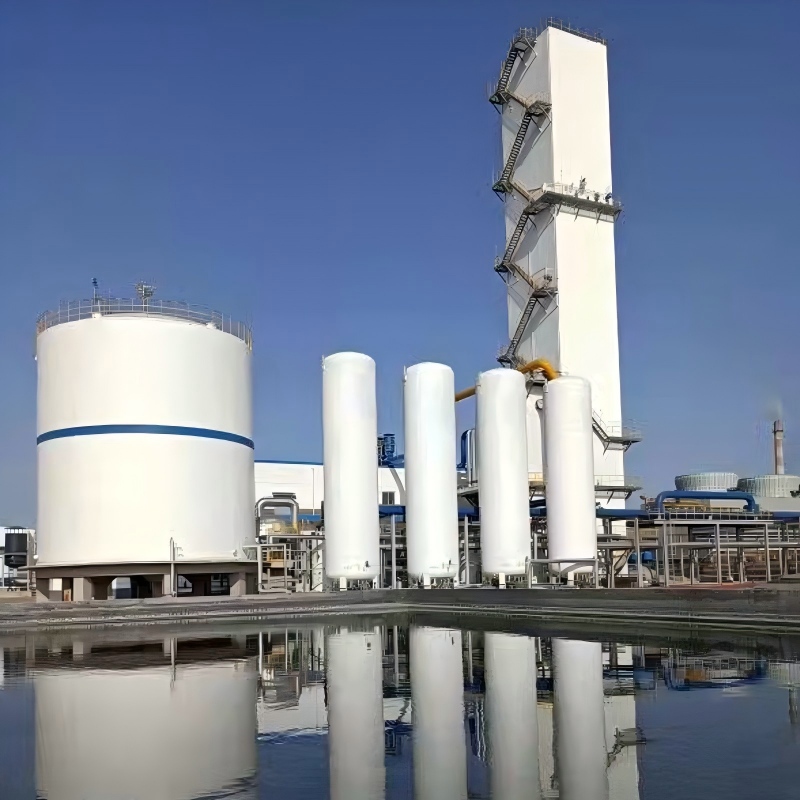
Cryogenic Air Separation Process
4.7 Liquid Nitrogen Storage Tank
It contains liquid nitrogen that has previously been made in a plant and is stored in the storage tank.
It uses vacuum insulation technology.
Therefore, evaporation losses remain low.
Storage tanks enable users to have a stable supply of LN2.
Related products:
Cryogenic Storage Tank
LCO2 Storage Tank
4.8 Control System
Control system to manage the entire liquefaction process.
Modern systems now employ PLC and automatic monitoring tech.
The control system manages:
l Pressure
l Temperature
l Flow rate
l Safety protection
Therefore, automation improves operation reliability.
All components of the nitrogen liquefaction system act as one cycle.
It starts with compression of nitrogen.
Then, pre-cooling reduces temperature.
After this are recovery processers which recover cooling energy.
Expansion equipment then produces deeper refrigeration from this.
And finally nitrogen is liquified at around -196°C.
The liquid nitrogen is then stored in a storage tank.
Hence, each element generates efficient production.
The Nitrogen liquefaction technology relies on advanced cryogenic refrigeration technology.
Common technologies include:
Linde-Hampson Cycle
It utilizes compression, cooling and Joule-Thomson expansion in this cycle.
Appropriate for little and medium frameworks.
Claude Cycle
Expansion catalysts and heat exchangers constitute the Claude cycle.
Therefore, it provides higher efficiency.
And this is the technology that many industrial systems are utilizing.
Mixed Refrigerant Technology
Better energy performance with mixed refrigerant systems
Consequently, operating costs decrease.
There are a number of considerations affecting the efficiency of nitrogen liquefaction.
Nitrogen Purity
Higher purity improves cooling performance.
Compressor Efficiency
Efficient compressors reduce power consumption.
Heat Exchanger Performance
Better energy recovery is provided by improved heat transfer.
Insulation Quality
Good insulation reduces cold loss.
Automation Level
Advanced controls improve system stability.
Therefore, the production cost is directly related to the quality of equipment.
Nitrogen Liquefaction systems are used for many different industries.
Food Processing
Liquid nitrogen enables rapid freezing.
Medical Industry
Liquid nitrogen supports biological preservation.
Pharmaceutical Industry
LN2 is used for storage applications by companies.
Electronics Manufacturing
Nitrogen cooling is utilized in factories for a precision process.
Chemical Industry
Nitrogen provides inert protection.
Scientific Research
We use cryogenic nitrogen for experiments in laboratories.
Internal Link Opportunities:
l Industrial Gas Plant
l Nitrogen Plant Manufacturer
l Liquid Oxygen Plant
|
Feature |
Nitrogen Liquefaction System |
PSA Nitrogen Generator |
|
Output |
Liquid Nitrogen |
Gas Nitrogen |
|
Temperature |
-196°C |
Ambient |
|
Storage |
Excellent |
Limited |
|
Investment |
Higher |
Lower |
|
Application |
Cryogenic Uses |
Gas Supply |
Therefore, users should select technology according to application needs.
Companies should evaluate several factors.
First, Calculate required liquid nitrogen capacity
Next, check nitrogen purity requirements.
Moreover, analyze energy consumption.
Furthermore, consider maintenance requirements.
Finally, choose an experienced manufacturer.
With the help of a professional supplier, you get an optimized design for your system.
About Nanjing Bangwin Gas industrial gas generation and cryogenic solutions
Official Website:
https://bangwingas.com/
The company provides:
l Nitrogen Liquefaction System
l Cryogenic Air Separation Plant
l Air Separation Unit
l PSA Nitrogen Generator
l PSA Oxygen Generator
l VPSA Oxygen Plant
l Cryogenic Equipment
Nanjing Bangwin Gas offers:
l Customized engineering design
l Complete equipment integration
l Energy-efficient solutions
l Installation support
l Technical service
As a result, customers get consistent and expert industrial gas businesses.
For cryogenic storage equipment:
https://bangwingascylinder.com/
1. What are the main nitrogen liquefaction system components?
The main components include compressors, heat exchangers, expansion turbines, cold boxes, storage tanks, and control systems.
2. What is the most important component in nitrogen liquefaction?
The heat exchanger and expansion turbine play critical roles because they provide the cooling required for liquefaction.
3. What temperature does nitrogen become liquid?
Nitrogen becomes liquid at approximately -196°C.
4. Can PSA nitrogen feed a liquefaction system?
Yes. A PSA nitrogen generator can provide nitrogen gas for some liquefaction systems.
5. Who supplies nitrogen liquefaction systems?
Nanjing Bangwin Gas provides customized nitrogen liquefaction systems and industrial gas solutions worldwide.
Knowledge of nitrogen liquefaction system components enables firms to create streamlined and effective liquid nitrogen-making systems.
The entire chain, from compressors to cryogenic storage tanks, plays a role in stable operation and energy efficiency.
This is why choosing the right equipment and a good engineering staff to back it up is critical.
Company can design and fabricate nitrogen liquefaction plants for small scale N2 gas output, designed to supply nitrogen continuously for the intended usages.
For more info on industrial gas generation systems, visit https://bangwingas.com/.



 IPv6 réseau pris en charge